
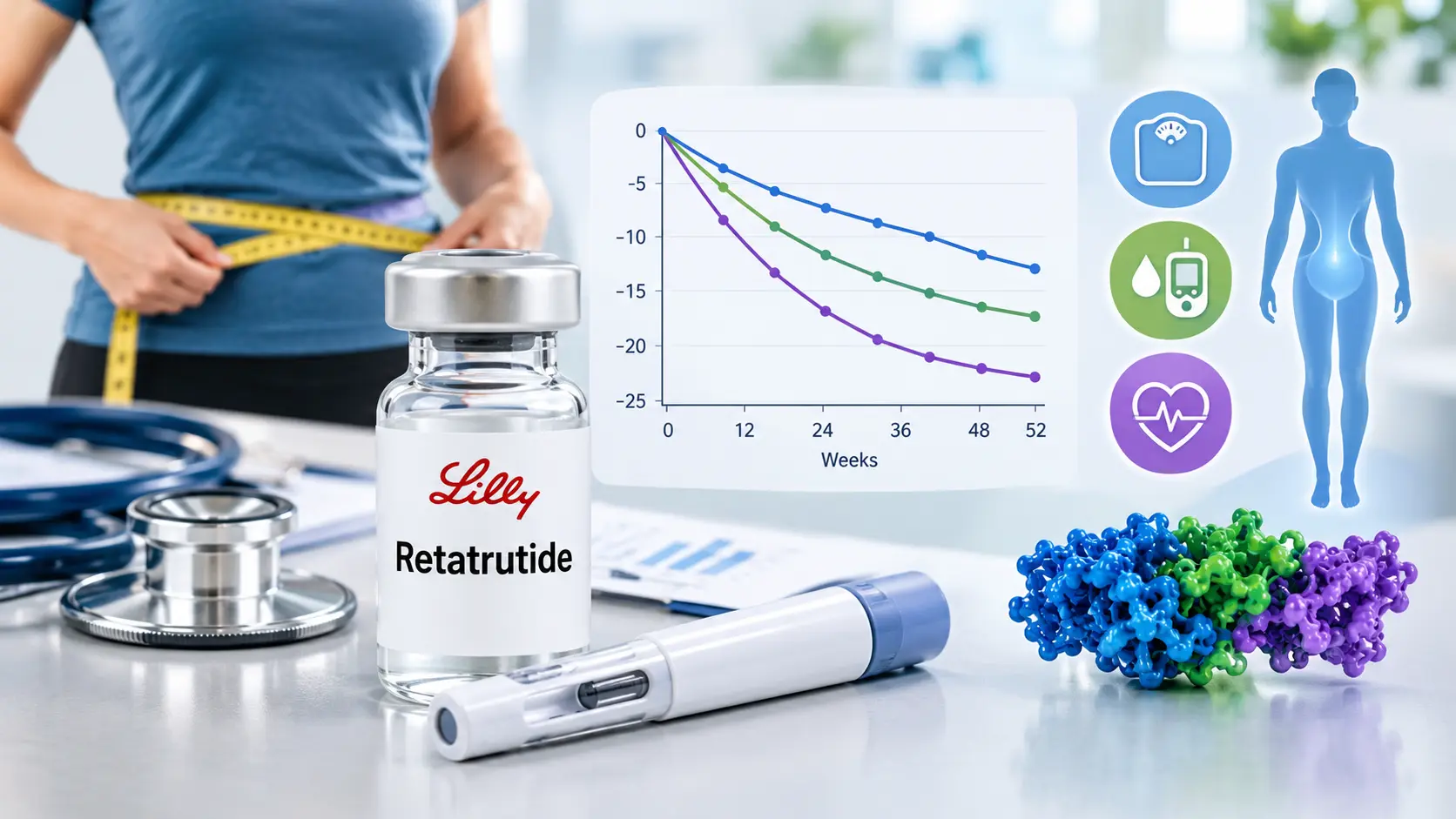
| Quick Answer Eli Lilly’s retatrutide, a once-weekly injection, helped people lose up to 28.3% of their body weight in 80 weeks during its biggest Phase III trial. It also improved blood sugar, blood pressure, and cholesterol. Side effects were mostly stomach-related, and some people dropped out because of them. Lilly plans to ask for FDA approval in early 2027. |
Retatrutide Phase III Results have recently captured global attention, and if you have been following any weight loss news, chances are you have heard about this breakthrough. Eli Lilly’s newest creation has officially completed phase III trials—the final stage of clinical testing before a drug can enter the marketplace. The outcomes of these trials are nothing short of remarkable, boasting the most impressive figures of any weight loss drug to date. But what do the numbers really mean? Let’s discuss the results in detail and see what they signify for the future of obesity treatment.
What Is Retatrutide, and Why Is Everyone Talking About It?
Retatrutide is a proposed once-weekly injectable drug, akin to Zepbound and Wegovy, but with a crucial difference — the new molecule is said to target three gut hormones, as opposed to one. Most anti-obesity drugs only mimic the activity of the single hormone GLP-1, but Retatrutide is said to influence GLP-1, GIP, and glucagon, simultaneously. In other words, the drug can be used to target three different “buttons” in the body that control hunger and energy expenditure, as opposed to one. This may explain why the pharmaceutical sector has taken a particular interest in the molecule — offering more mechanisms of action is likely to be associated with greater therapeutic benefits.
Key Takeaways From the Retatrutide Phase III Trials
- Record weight loss: up to 28.3% of body weight lost on average at the highest dose over 80 weeks.
- Nearly half of patients on the top dose lost 30% or more of their starting weight.
- 65.3% of people on the 12 mg dose dropped below the BMI cut-off for obesity.
- It also helped people with type 2 diabetes, lowering blood sugar (A1C) by up to 2.0%.
- Heart health markers improved too — blood pressure, cholesterol, and inflammation all went down.
- Side effects were mostly nausea, diarrhoea, and a tingling skin sensation at higher doses.
- Lilly plans to file for FDA approval in the first quarter of 2027.
TRIUMPH-1: How Much Weight Can You Really Lose?
TRIUMPH-1 is the headline trial. It followed 2,339 adults with obesity or overweight, none of whom had diabetes, for 80 weeks — that’s just over a year and a half. People were split into groups and given either a placebo (a dummy jab) or retatrutide at 4 mg, 9 mg, or 12 mg once a week. Here’s what the weight loss looked like at the end of the study:
| Dose | Average weight lost | % body weight lost |
| 4 mg | 47.2 lbs | 19.0% |
| 9 mg | 64.4 lbs | 25.9% |
| 12 mg | 70.3 lbs | 28.3% |
| Placebo | Minimal | Under 3% |
To put that in perspective, 28.3% weight loss is in the same ballpark as what many people lose after certain types of weight loss surgery — but from a weekly injection instead of an operation. In a smaller group of patients who kept going to 104 weeks, weight loss reached as high as 30.3%. That’s genuinely rare for a medicine rather than a surgical procedure.
TRIUMPH-2 and TRIUMPH-3: Help for Diabetes and Heart Risk
Weight loss was not the only outcome studied. The TRIUMPH-2 trial examined the efficacy and safety of the drug in patients with obesity and type 2 diabetes. The results revealed that all three tested doses of the medication reduced body weight and improved glycemic control during an 80-week treatment period. Moreover, the findings of TRIUMPH-3 trial indicate that the drug can be beneficial for people with extreme obesity and obesity with cardiovascular disease since it caused significant weight loss in this population too without raising any safety concerns.
TRANSCEND-T2D-1: What About Blood Sugar on Its Own?
An earlier trial, TRANSCEND-T2D-1, focused purely on people with type 2 diabetes over 40 weeks. Retatrutide lowered A1C (a key blood sugar marker) by up to 2.0% and helped patients lose an average of 16.8% of their body weight — and weight loss was still going at the 40-week mark, with no sign of levelling off. For context, A1C drops of that size are considered a big deal in diabetes care.
Side Effects and Safety: What to Watch For
No drug is perfect, and retatrutide is no exception. The most common adverse effects were typical for this class of drugs: nausea, diarrhea, and dyspepsia, which occurred more often when the dose was higher. A smaller but still significant number of patients taking the highest dose reported dysesthesia – a tingling sensation on the skin. Discontinuation rates (the percentage of patients who had to stop treatment due to side effects) ranged from about 4% to 18%, depending on the trial and dose, compared to about 4-5% for placebo. Thus, it can be seen that the higher the dose, the better the result, but the lower the retention rate.
How Does Retatrutide Compare to Other Weight Loss Drugs?
Against Lilly’s own Zepbound and Novo Nordisk’s Wegovy, retatrutide’s weight loss numbers are higher across the board in cross-trial comparisons, though it’s worth remembering these are separate studies, not a direct head-to-head race. Its three-hormone approach appears to be the reason it edges ahead. Whether that gap holds up once it’s used by millions of people in the real world, outside a closely monitored trial, is something only time — and more data — will answer.
When Will Retatrutide Be Available?
Lilly has said it plans to submit a Biologics License Application to the FDA in the first quarter of 2027. If that goes smoothly, approval and a public launch could realistically follow later that year, though drug approvals can and do slip. Until then, retatrutide remains available only through clinical trials, not pharmacies.
Quick Answers
Does retatrutide work better than Zepbound? Early trial data suggests yes, but there’s no direct head-to-head study yet, so take comparisons with a pinch of salt.
Is retatrutide approved yet? No. It’s still in the FDA review pipeline, with a filing expected in early 2027.
What are the main side effects? Nausea, diarrhoea, and in some cases a tingling skin sensation at higher doses.
Who was tested in these trials? Over 2,300 adults with obesity, with separate trials covering type 2 diabetes and existing heart disease.
The Bottom Line
The results of the III phase trials of Retatrutide show the most outstanding model of body weight reduction, with almost a third of patients’ weight loss and significant improvements in glucose and cardiovascular metrics. Moreover, the results have tolerable side effect profiles, although they should be taken with a grain of salt. This drug is not ready for prescription, as it still needs the approval of the FDA. However, if the results are confirmed, the medication may become one of the most popular weight-loss drugs in the history of medicine. The information provided shall not be considered as medical advice, and patients should consult their doctors before making any decisions concerning treatments and medications.
References and Resources
- Eli Lilly: TRIUMPH-1 Phase 3 topline results (investor.lilly.com)
- Eli Lilly: TRIUMPH-2 and TRIUMPH-3 results (investor.lilly.com)
- Eli Lilly: TRANSCEND-T2D-1 results (investor.lilly.com)
- CNBC: Eli Lilly’s weight loss drug clears obesity trial
- AJMC: Retatrutide Achieves Up to 30.3% Average Weight Loss
- Wikipedia: Retatrutide overview