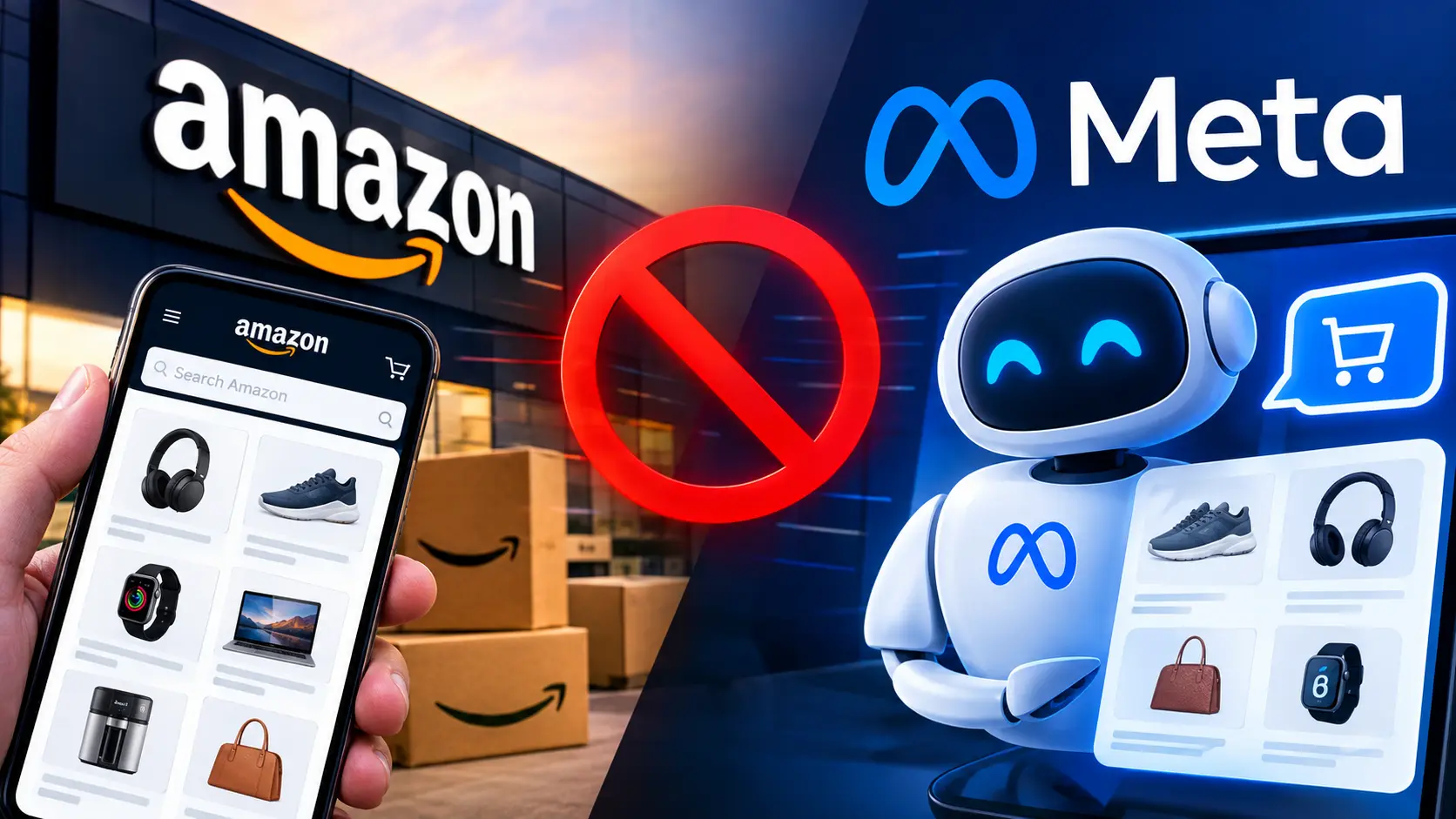
| Quick Answer Amazon has blocked Meta’s Muse AI agent from shopping on Amazon.com due to the parent company’s unauthorized launch. Amazon claims Muse failed to identify itself while browsing the site, could capture and store customer credentials and access account and order information without permission. They asked Meta to remove Muse from their site, but it refused. Amazon turned on the block, so any attempt by Muse to shop on Amazon will result in a pop-up warning that it violates Amazon’s terms of use. |
In the ongoing battle of Amazon vs Meta Muse, Amazon has officially blocked Meta’s new AI shopping agent from accessing its platform. If you have been following tech news this week, you might have come across Amazon’s latest spat with Meta—a major feud over data privacy, platform access, and controlling the online ‘buy’ button.
If you have been following tech news this week, you might have come across Amazon’s latest spat with Meta. It is not about data privacy or advertising. Amazon is upset with Meta’s new AI ‘agent’ Muse, which can shop, book, and pay for users. While it may seem like just another tech row, this is just the beginning of a much bigger fight over controlling the ‘buy’ button.
Let’s break down what actually happened, in plain English.
What Is Meta Muse, and What Does It Actually Do?
Meta announced Muse as an innovative personal AI agent on 8 September 2026, going beyond a simple chatbot. It enables users to perform actions like sending emails and making travel arrangements, launching a browser, filling forms and negotiating on the user’s behalf, and completing a checkout. The AI can continue performing tasks after closing the application. It aims to act as an AI assistant that users may actually want to perform basic errands for while they are occupied elsewhere.
Muse is available in the US on iOS, Android, the web, and WhatsApp, with most of them being free to use and two premium subscriptions for heavy users. For payments, Muse uses Link by Stripe, which creates a one-time card to pay, ensuring that credit card details are not shared with the website or application.
Muse is already one of the most downloaded applications in the US and has become one of the most popular AI apps on the Apple App Store since its launch, briefly overtaking ChatGPT. It is a significant concern for Amazon.
Why Did Amazon Actually Block It?
Here is the thing: Amazon does not prohibit all kinds of AI; they have their own shopping agents. The problem was one of control, permission, and compensation.
Amazon does not allow other firms to operate automated shopping agents on its platform, and they terminated Muse’s access to their website last Sunday evening, after requesting Meta to delete the bot, which they refused. Users who tried to use Muse to shop on Amazon were greeted with a pop-up alert saying that the bot violated their terms of use.
Their justification was based on fairness and transparency; an Amazon spokesperson stated that third-party apps that perform purchases on behalf of customers should operate in a transparent manner and disclose their presence, just as food delivery and online travel agencies do with their affiliated restaurants and hotels.
The issue was further compounded by a security concern: Amazon claimed that Meta had not disclosed to them that Muse would be accessing the Amazon store, that the shopping bot did not identify itself while browsing the website, and that it may have been capturing and storing users’ credentials. Meta strongly disagreed with the latter, but Amazon remained unmoved.
Finally, there is the matter of compensation. Amazon’s revenue from advertisements is estimated at over $68 billion, based on last year’s figures alone. These are derived from their ability to ensure that ads get displayed to users who are browsing the web. If an AI agent is browsing without users actively engaging with the e-commerce site, then the value of such an arrangement to advertisers is significantly diminished. Therefore, Amazon has every reason to ensure that third-party bots do not undermine its business model.
What Does Meta Say About the Credential Concerns?
Meta pushes back hard on the security claims. Meta says the Muse model can’t actually see users’ passwords or payment details — those stay in secure storage and are only used behind the scenes for authentication. Under the bonnet, each Muse runs inside its own cloud environment called Muse Secure VM, and a separate system called Sentinel controls what the agent is allowed to send out to the internet.
In other words, Meta’s position is: our safety net is solid, and Amazon’s real objection is business, not security.
This Isn’t Amazon’s First Bot Fight
Amazon has been fighting a losing battle for quite some time. Amazon has taken legal action against Perplexity over its Comet browser and has taken steps to block shopping agents on Google and OpenAI. It updated the robots.txt file, which indicates to search spiders which files are open and which are not, to prohibit new AI agents from Google. However, other companies do not see eye to eye with Amazon on the matter. The day after Amazon blocked its access, Shopify’s chief executive announced his plans to do the opposite and began collaborating with Muse to enable agentic checkouts in all Shopify stores.
It is helpful to see how different companies in the same market may position their strategies differently. Amazon’s position is understandable as they have their storefronts and ads, a significant source of their revenue. On the contrary, Shopify does not rely on Google Ads the same way Amazon does; hence, the company views agentic shopping as an opportunity rather than a threat to its business.
What This Actually Means for You
If you are an everyday shopper, the most important thing to know is this: for now, you can’t use Meta’s Muse to make purchases on Amazon. There will be pop-ups explaining that, but you can still use Muse for plenty of other things. It will work on Shopify stores, but not Amazon, at least until the two companies work out a deal.
In general, though, this is a sign of things to come. As online shopping becomes more common, expect major sites to decide, one by one, whether they want to embrace or oppose AI assistants. Either way, the battle is sure to be waged.
Frequently Asked Questions
Why did Amazon block Meta’s Muse?
Amazon says Muse accessed its site without permission, didn’t identify itself as a bot, and could reach account and order details, and it wants third-party agents to ask first, the same way delivery apps do with restaurants.
Can I still use Muse to shop anywhere?
Yes. Muse can shop on Shopify-powered stores, which have partnered with Meta to support agentic checkout. It just can’t complete purchases on Amazon.com right now.
Is Meta Muse safe to use?
Meta says passwords and payment details are hidden from the AI model itself and stored separately for security. As with any new AI tool, it’s sensible to review what accounts and permissions you connect to it.
Has Amazon blocked other AI shopping bots before?
Yes. Amazon has previously restricted or taken legal action against AI shopping agents from Perplexity, Google, and OpenAI, so this isn’t a one-off dispute with Meta.
Will Amazon and Meta reach an agreement eventually?
Possibly. Amazon has said it’s in direct talks with Meta about the issue, though neither company has confirmed a resolution yet.
Further Reading & Resources
Bloomberg: Amazon Blocks Meta’s Muse AI Agent From Its Retail Site
GeekWire: Amazon blocks Meta’s Muse AI assistant in new standoff over agentic shopping
The Register: Amazon shows Meta’s Muse AI shopping agent the door
TechRepublic: Meta Launches Muse AI Agent to Run Errands, Book Travel, and Shop