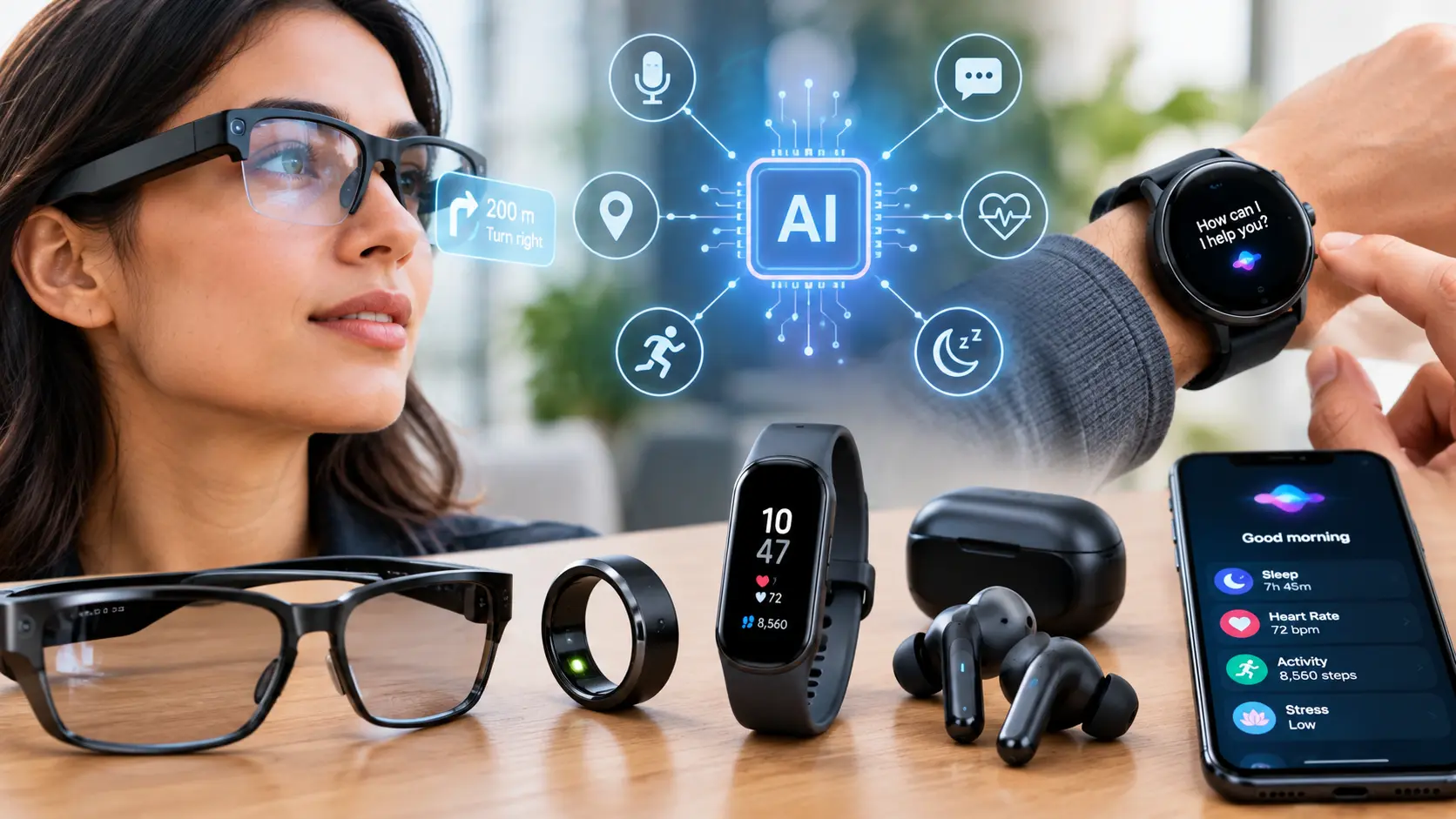
| Quick Answer The latest AI wearable devices include smart glasses (Ray-Ban Meta, Even Realities), AI pendants and pins (Plaud, Limitless, Bee), smart rings (Oura, Samsung Galaxy Ring), and AI earbuds with live translation. They work by using built-in microphones, cameras, or sensors to collect data, then process it with on-device or cloud-based AI to give you summaries, health insights, or spoken answers in real time. |
A few years ago, ‘wearable tech’ used to mean a watch that told you how many steps you made that day. Times have changed, and now we have smart wearable devices that can listen to you at a meeting and take notes for you, translate what someone is saying to you in another language in real-time, or alert you to the fact that you are coming down with something before you even feel ill. If you feel like you need some background on the concept, this article can give you an intro in layman’s terms.
What Actually Counts as an “AI Wearable”?
In short, an AI wearable is a wearable device that utilizes artificial intelligence to offer additional benefits beyond simple data collection. A fitness tracker that only counts steps is not an AI wearable. But a ring that analyzes your sleep cycles over the course of several nights and identifies the reason for your fatigue is.
Sensors have been around for a long time – microphones, cameras, and heart rate monitors. The technology that constitutes an AI wearable is the additional layer of artificial intelligence which perceives patterns within the data collected by sensors and identifies those patterns in a way that humans can comprehend and explain.
The Latest AI Wearable Devices You Can Buy Right Now
The market has split into a few clear categories, and each one solves a different everyday problem. Here’s a quick look before we go deeper.
| Wearable Type | Example Devices | Main Job |
| AI smart glasses | Ray-Ban Meta, Even Realities G2 | Voice help, translation, hands-free photos |
| AI pendants/pins | Plaud NotePin, Limitless, Bee | Record chats, write summaries and to-do lists |
| Smart rings | Oura Ring 4, Samsung Galaxy Ring | Track sleep, health and readiness scores |
| AI earbuds | Various 2026 translation earbuds | Real-time spoken language translation |
1. AI Smart Glasses
Smart glasses have quietly become one of the most popular AI wearables of 2026. The Ray-Ban Meta line remains a bestseller, blending normal-looking frames with a built-in AI assistant that can identify what you’re looking at, give directions, or snap a photo hands-free. Newer entrants like Even Realities G2 add small in-lens displays, so you can glance at a translation or a text message without pulling out your phone.
2. AI Pendants and Pins
This part of the market is growing fastest. Devices such as the Plaud NotePin, the Limitless pendant and the Bee attach to your clothing or a lanyard and record conversations on the move during the day. Later, an app creates a summary of hours of conversation in a digestible form with actionable items for you, ideal for someone sitting through endless back-to-back meetings or lectures.
3. Smart Rings
Rings have become the ultimate status symbol for anyone who finds a watch too big. Oura Ring 4 is seen as the gold standard, using AI to combine temperature, activity, and heart data into a single “readiness” score that it reveals every morning. Samsung’s Galaxy Ring offers something similar, but with no subscription fee, for those who already own a Samsung device.
4. AI-Powered Earbuds
Real-time translation earbuds are coming. Say something in English, and the person across the room will hear it in his or her language, coming out of special tiny earbuds. There are some glitches, but these baby buds are already plenty helpful for travel and communications with people who speak other languages.
How Do AI Wearables Actually Work?
Underneath the marketing language, every AI wearable follows roughly the same three steps.
- Step 1 — Collect: A microphone, camera, or body sensor gathers raw information, such as sound, movement, or heart rate.
- Step 2 — Process: That raw data gets sent to an AI model, either on the device itself (“on-device AI”) or up to the cloud, where patterns are worked out.
- Step 3 — Explain: The wearable, or its companion phone app, turns that pattern into something you can use — a written summary, a spoken translation, or a simple health score.
Processing on the device itself allows for faster and more private data analysis; your voice or health information never leaves the device. Cloud-based processing is more powerful, but it requires an internet connection and sends your data elsewhere for analysis, which may be a concern for some users.
Most AI wearables connect to the phone via Bluetooth, saving battery while providing a steady stream of data for the application. The application is performing most of the hard work; it displays summaries, graphs, and provides general information about the data, as well as options to customize one’s privacy settings.
Are AI Wearables Actually Worth Buying?
It is better to consider the intended use rather than the impressiveness of technology. For instance, if someone has to attend many meetings, an AI pin or pendant can be helpful. If a person prioritizes rest, smart rings can be a great investment. If someone travels a lot or works in an environment where they communicate with people who have language barriers, smart glasses or earbuds can be worth the money.
On the contrary, if someone already owns a smartwatch, but likes to concentrate on step counting and do not want to invest in another smart device, their attitude has nothing wrong. The battery, price, and privacy may differ from brand to brand; therefore, it is essential to check recent critiques and reviews.
The Bottom Line
AI wearables in 2026 aren’t about replacing your phone. They’re about handling small, specific jobs — remembering what was said in a meeting, understanding your sleep, or bridging a language gap — quietly, in the background, without you having to think about it. Pick the one that solves a problem you actually have, and skip the rest.
Frequently Asked Questions
What is an AI wearable device?
An AI wearable is a small gadget you wear — like glasses, a ring, or a clip — that uses artificial intelligence to listen, watch, or track your body, then turns that information into something useful, such as a summary, a health score, or spoken advice.
Are AI wearables safe to use?
Most reputable AI wearables use encrypted storage and let you review what’s recorded. Still, always check the privacy policy, look for on-device processing where possible, and be mindful of local recording consent laws before using one around other people.
Do I need my phone with an AI wearable?
Yes, in nearly all cases. Most current AI wearables pair with a smartphone app over Bluetooth to store data, run the fuller AI features, and show you summaries or health trends.
What’s the difference between AI wearables and normal fitness trackers?
A normal fitness tracker mostly counts steps and heart rate. An AI wearable goes further, using AI to interpret that data, hold conversations, transcribe meetings, translate speech, or predict illness before you feel it.
How long does the battery last on AI wearables?
It varies by device type. AI pendants and pins often run for several days between charges, smart rings can last around 4 to 7 days, and AI glasses with cameras typically need charging every 1 to 2 days with regular use.
Sources & Further Reading
- Forbes Vetted — Best AI Wearables 2026 (hands-on testing) — https://www.forbes.com/sites/forbes-personal-shopper/article/best-ai-wearables/
- The Gadgeteer — 6 Latest Wearables You May Have Missed in 2026 — https://the-gadgeteer.com/2026/09/15/latest-wearables-2026/